In my recent process, I keep circling a fundamental question: how do I approach uncertainty?
How do I connect with Achiamma, a person I had never really known?
For much of my life, ambivalence felt like a curse. Not knowing meant I could not decide, could not settle. It often led me into paralysis.
Over time, though, something shifted. I began to sense that the unknown was not only an obstacle. It could also be a companion.
Now, instead of fearing it, I explore not knowing as a method. A way of working. A way of weaving.
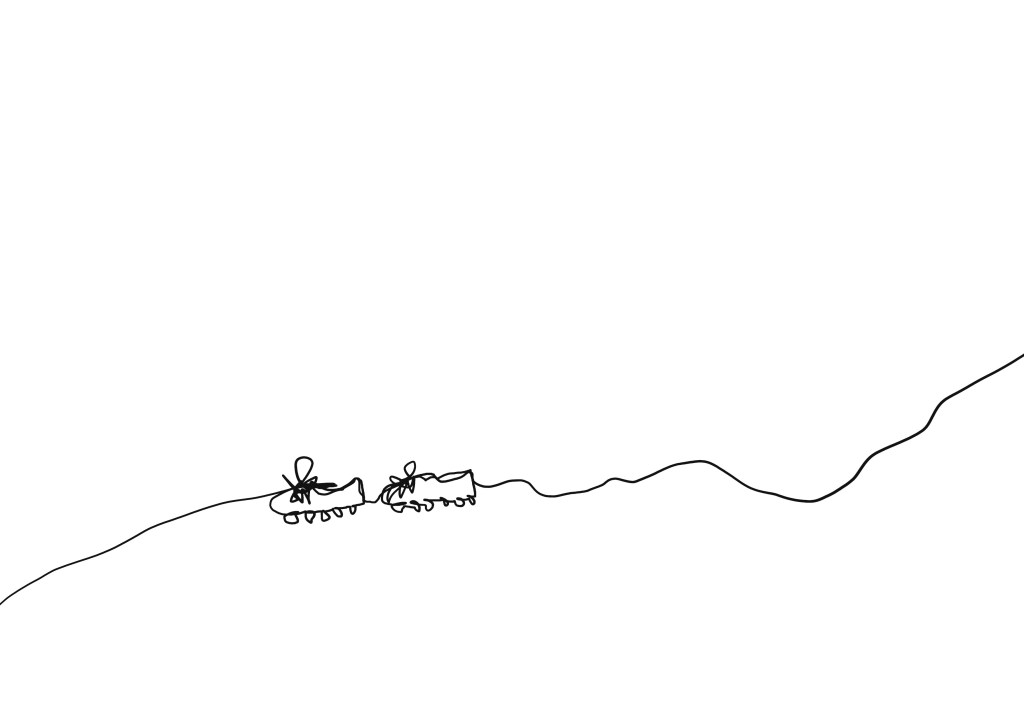
Throughout the process of creating Achiamma, this way of exploring what cannot be known has turned into a speculative, recursive map, not a straight line but a looping thread, weaving me back again and again to what I do not know (yet).
I have come to recognise four recurring practices that guide me in this approach:
1. Honesty about the unknown. I try to state clearly what I do not know. I resist the pull to form an early answer. This boundary-making is productive in itself. It marks the edges of the map.
2. Openness to revision. What feels true today may shift tomorrow. I leave space for my earlier certainties to soften or change. This keeps me from becoming rigid.
3. Recursive return. I revisit questions again and again. Each time I return with a slightly different angle, or a new experience. The knowledge deepens in layers, choosing non-linearity in favour of a straight line.
4. Holding paradox. Contradictions are not failures. They are signs of complexity. By sitting with paradox, I let multiple truths co-exist, letting a more nuanced form of understanding slowly emerge.
This allows me to approach epistemologies themselves as constructivist metaphors and lenses rather than ultimate truths. Each framework, whether feminist, scientific, decolonial, indigenous, somatic, or spiritual, offers a way of seeing, not truth itself.
By treating epistemologies as metaphors, I remain free to use them provisionally, to shift between them, and to resist dogma and rigid beliefs.
To me, these recursive epistemologies are not an academic abstraction, they are a lived practice. They emerge from my neurodivergent way of processing. From seeing patterns. From holding fragments. From returning again and again. Not knowing, un-knowing, re-knowing.
Allowing myself to not know and un-know offers relief. Space to breathe. To explore. It gives me permission to sit with what I cannot know (yet), trusting that a form of deeper knowing may wait on the other side. In this sense, I create a space, an environment where knowing can emerge, a space where Achiamma can appear, faintly, obliquely, without being forced into definition.
This is vital for my artistic practice. It enables me to build alternative epistemologies and explore ontologies through phenomenology, through touch, through the felt texture of living, through what experience leaves behind. By finding new ways of connecting ideas, bodies, and histories, I don’t depend on certainty. I explore being-with instead of clear definition, I iterate through cycles of knowing, un-knowing, and re-knowing.
Achiamma explores memory and absence without searching for definitive truths. It maps traces, loops, and echoes. Not knowing allows these traces to remain alive, opening new possibilities for meaning-making.
I now recognise uncertainty as a fundamental thread in my research: it delineates the unknown, redraws maps through revision, deepens knowledge recursively, and sustains complexity without collapsing it into a fixed truth. In this way, the unknown is not the absence of knowing but the texture of my practice, a weaving of echoes, pauses, and returns that make my art possible. So I return again to uncertainty. Not as a curse, but as a companion, a loom on which my practice keeps weaving itself, sometimes loose, sometimes tangled, always thread by thread, into being.
Related Concepts
This recursive practice does not stand alone; it resonates with and extends wider conversations in feminist, constructivist, and emergent epistemologies. The following concepts have been especially important companions to my thinking.
Feminist Epistemology & Situated Knowledge
Donna Haraway’s concept of situated knowledges reminds us that all knowledge arises from specific embodied and historical positions, never from a neutral or universal vantage point (Haraway, 1988). Feminist epistemology more broadly critiques dominant ideals of objectivity. Thinkers such as Sandra Harding and Lorraine Code argue for standpoint theory, which values knowledge grounded in marginalised or fragmented experiences (Harding, 1991; Code, 1991).
Constructivist Epistemology
Constructivist thought, articulated by Berger and Luckmann in The Social Construction of Reality (1966), holds that knowledge is not a mirror of reality, but something shaped through models and social context. Feminist constructivism builds on this but brings in power, identity, and politics: knowledge is constructed, but also shaped by cultural and gendered norms.
Diffraction & Agential Realism
Karen Barad’s Meeting the Universe Halfway (2007) introduces agential realism, which dissolves boundaries between knowledge, ethics, and ontology, showing how our knowing and being are inseparable. Her method of diffraction, developed in dialogue with Haraway’s earlier work (1992), invites us to map differences through relational engagement, rather than seeking reflection or sameness.
Paradox & Knowledge Construction
The knowledge paradox shows how every concept, while necessary for understanding, inevitably distances us from the fluidity of lived reality. Writers like Michael Smithson (1989) and Edgar Morin (2008) emphasise paradox as not a flaw but a generative condition of knowledge, reminding us that complexity always resists full capture.
Emergent Strategy
adrienne maree brown’s Emergent Strategy (2017) explores how shaping environments, rather than forcing outcomes, allows transformation to unfold. For her, social movements grow through adaptation, relationship, and iterative processes, a vision that resonates with creating spaces where knowing can emerge without coercion.
 Leah M. Bowie